
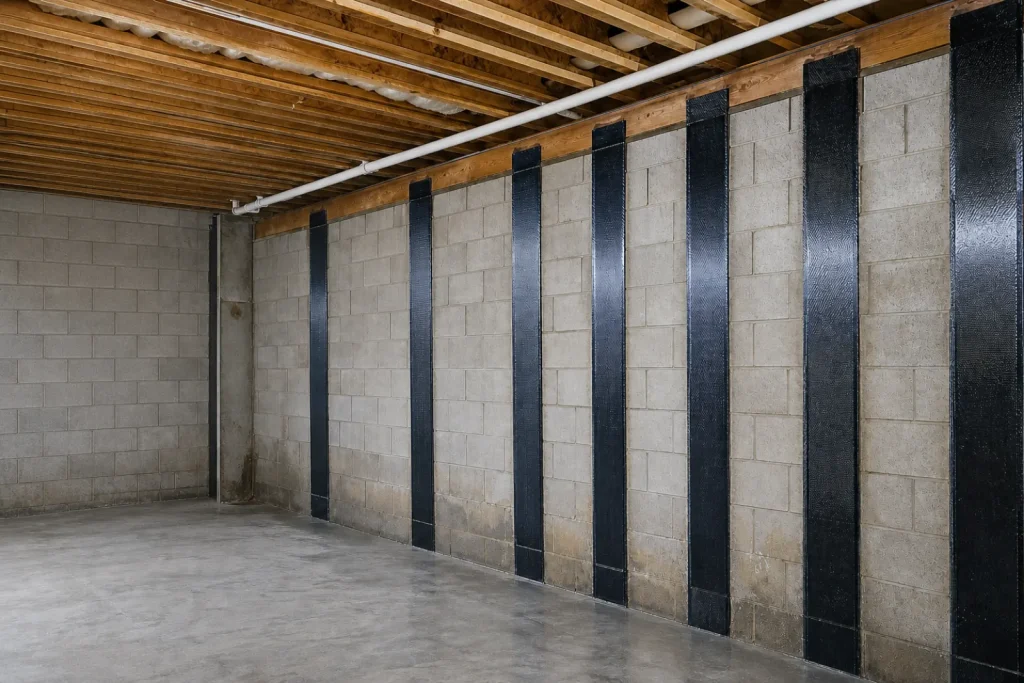
Discovering a crack in your basement wall can be unsettling. Whether you notice a thin hairline gap while moving storage boxes or a wider fracture following a mortar joint, it is natural to wonder what caused it, whether it is getting worse, and what it means for your home.
First, take a breath: the presence of a foundation crack does not automatically mean your home is experiencing a serious structural problem.
Concrete and masonry are rigid materials resting on soil that can shift as drainage, moisture, weather, and other site conditions change. Some cracks may be associated with concrete curing or minor movement, while others can indicate pressure or settlement that deserves professional attention.
The direction, location, pattern, and surrounding conditions provide useful clues, but a crack should never be diagnosed by appearance alone. This guide explains the most common types of foundation cracks, what horizontal, vertical, diagonal, and stair-step patterns may indicate, and which accompanying warning signs should prompt a professional foundation inspection.
Why Foundation Crack Patterns Matter
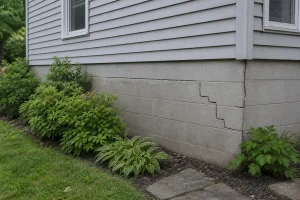
Foundation cracks can develop when pressure, movement, or changes in the surrounding ground place stress on concrete or masonry.
Different forces may produce different crack patterns. A crack that runs vertically may have a different cause than one that travels horizontally across a basement wall or follows the mortar joints in a stair-step pattern.
Examining the crack’s orientation can help homeowners understand the possibilities. However, the complete condition of the foundation—including drainage, grading, wall alignment, moisture, and changes elsewhere in the home—must also be considered.
1. Horizontal Foundation Cracks
A horizontal crack in a basement wall—whether it runs across poured concrete or follows the mortar joints of a concrete block foundation—deserves careful professional attention.
What Can Cause Horizontal Cracks?
Horizontal cracks may be associated with lateral pressure acting against the exterior of the foundation wall.
Heavy rainfall, snowmelt, inadequate drainage, saturated ground, and seasonal freeze-thaw conditions can affect the amount of pressure surrounding a foundation. If pressure increases against the wall, the wall may begin moving inward and a horizontal crack can develop.
Not every horizontal crack represents the same condition or level of movement. Its location, length, displacement, moisture, and relationship to the rest of the wall should be evaluated together.
Why Should Horizontal Cracks Be Evaluated?
Horizontal cracks are less commonly associated with ordinary concrete curing than narrow vertical cracks. They may indicate that pressure has acted on the wall, particularly when accompanied by visible bowing, separation along mortar joints, or inward displacement.
A professional foundation inspection can help determine whether the wall appears stable, whether movement may be continuing, and what repair options could be appropriate.
2. Vertical Foundation Cracks
A vertical foundation crack runs straight or nearly straight up and down a poured concrete or masonry wall.
What Can Cause Vertical Cracks?
Some vertical cracks develop as concrete cures and contracts. Others may be associated with localized movement, settlement, moisture, or stress around a particular section of the foundation.
A narrow vertical crack with no visible displacement, moisture intrusion, or ongoing change may be associated with concrete curing or minor movement. However, its history and surrounding conditions still matter.
When Should a Vertical Crack Be Evaluated?
Consider requesting a professional inspection when:
- The crack appears to be widening or lengthening.
- One side of the crack is displaced from the other.
- Water enters through the crack during wet weather.
- The crack is wider at one end.
- Additional cracks appear nearby.
- Doors, windows, floors, or walls elsewhere in the home show signs of movement.
Monitoring a crack with dated photographs can help document changes, but photographs cannot replace an on-site evaluation when movement or moisture is present.
3. Stair-Step Cracks in Concrete Block Walls
In concrete block foundations, cracks often follow the mortar joints between blocks, creating a distinctive stair-step pattern.
What Can Cause Stair-Step Cracks?
Stair-step cracks may be associated with:
- Uneven foundation settlement: One portion of the foundation may move differently from an adjacent section.
- Pressure against the wall: Outside pressure can create movement that follows weaker mortar joints.
- Localized drainage or soil conditions: Water collecting near a foundation corner or changes in ground support may contribute to movement.
A stair-step pattern indicates that movement has occurred somewhere along the wall or foundation. It does not, by itself, identify the exact cause or required repair.
Why Do Mortar Joints Matter?
Mortar connects the individual concrete blocks within the wall. When pressure or movement affects a block foundation, cracks may follow these joints because they respond differently than the surrounding concrete blocks.
The crack pattern should be evaluated along with wall alignment, moisture, displacement, exterior drainage, and changes elsewhere in the home.
4. Diagonal Cracks and Cracks Near Openings
A diagonal foundation crack travels at an angle across the wall. These cracks sometimes develop near basement windows, doors, walkout entrances, or other openings.
What Can Cause Diagonal Cracks?
Possible contributing factors include:
- Stress concentrated around the corners of a window or door opening.
- Uneven movement beneath one section of the foundation.
- Changes in drainage or ground support.
- Movement between different building materials.
- Normal curing or localized stress, depending on the crack’s condition.
The direction of the crack is only one piece of evidence. Its width, displacement, moisture, history, and surrounding conditions are equally important.
Comparing Foundation Crack Types
| Crack pattern | Visual characteristics | Possible contributing factors | Recommended next step |
|---|---|---|---|
| Vertical hairline | Runs generally up and down with little or no visible displacement. | Concrete curing, shrinkage, or minor movement may contribute. | Monitor for changes, moisture, or displacement and request an evaluation if concerns develop. |
| Horizontal crack | Runs sideways across a poured concrete or block wall. | May be associated with lateral pressure or inward wall movement. | Schedule a professional foundation inspection. |
| Stair-step crack | Follows mortar joints in a diagonal stair-step pattern. | May be related to uneven settlement or wall movement. | Have the crack and surrounding foundation conditions evaluated. |
| Diagonal crack near an opening | Extends from the corner of a basement window or door. | Stress around the opening or uneven movement may contribute. | Evaluate its displacement, moisture, and changes over time. |
Warning Signs That Deserve Professional Attention
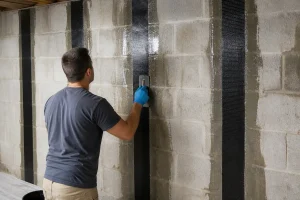
A crack should not be judged in isolation. What is happening around it—and throughout the rest of the home—provides essential context.
Consider scheduling a professional foundation evaluation if you notice:
- Visible inward bowing: The center of the foundation wall appears to curve or lean inward.
- Displacement at the crack: One side of the concrete, block, or mortar joint protrudes beyond the other.
- Active moisture seepage: Water enters through the crack during or after wet weather.
- Sticking doors or windows: Openings elsewhere in the home become difficult to operate or no longer align properly.
- Diagonal drywall cracks: Cracks appear above doors, windows, or other openings in the living area.
- Uneven or changing floors: Floors begin sloping, dipping, or feeling different underfoot.
- A widening or lengthening crack: A previously stable crack changes noticeably over time.
- Multiple related symptoms: Cracking appears together with bowing, moisture, displacement, or movement elsewhere in the home.
If a crack changes suddenly or appears alongside significant wall movement, seek qualified professional guidance promptly.
Why Foundations Require a Complete Evaluation
It may be tempting to compare a crack with online photographs and attempt to diagnose the problem. However, foundation movement can have multiple contributing factors.
For example, a crack near one corner of a basement could be associated with roof runoff collecting near the foundation, exterior grading, localized settlement, pressure against the wall, or a combination of conditions.
A professional inspection may consider:
- Exterior grading and roof runoff: How water moves around the foundation.
- Wall alignment: Whether the wall appears straight, leaning, or bowed.
- Crack displacement: Whether the two sides remain aligned.
- Moisture conditions: Whether water enters through the crack or surrounding masonry.
- Local environmental conditions: Drainage, soil, rainfall, snowmelt, and seasonal freeze-thaw cycles.
- Changes elsewhere in the home: Sticking doors, drywall cracks, uneven floors, or gaps around openings.
Looking at the entire foundation helps prevent a single crack pattern from being mistaken for a complete diagnosis.
Professional Foundation Repair Categories
The appropriate repair depends on the cause, condition, and extent of the movement. A reputable contractor should inspect the home and explain why a particular solution may be suitable instead of recommending the same system for every foundation.
Possible repair categories include:
- Wall stabilization straps: Depending on the condition of the wall, carbon fiber wall straps may be considered as a reinforcement option for certain bowing or cracking walls.
- Structural steel bracing: Steel beam reinforcement may be recommended for some basement walls requiring substantial structural support.
- Foundation underpinning: When movement is associated with settlement beneath the foundation, foundation underpinning may be considered to help stabilize and strengthen the affected area.
- Water-management improvements: If moisture or drainage contributes to the problem, the overall repair plan may also need to address how water moves around or beneath the foundation.
These descriptions are general. The appropriate solution cannot be selected from the crack’s appearance alone.
When to Request a Professional Foundation Inspection
Consider contacting a local foundation professional when:
- You discover a horizontal crack in a poured concrete or block foundation wall.
- A stair-step crack shows visible separation, displacement, widening, or related wall movement.
- You observe bowing, leaning, or displacement.
- Water consistently enters through a crack during wet weather.
- Doors, windows, drywall, or floors show related signs of movement.
- A crack changes noticeably over time.
- You are preparing to buy, sell, finish, or remodel a home and want greater clarity about the foundation.
An experienced contractor can examine the surrounding conditions, explain the findings in understandable terms, and recommend appropriate next steps. If engineering input is necessary, the homeowner may also be advised to consult a licensed structural engineer.
Honest, Pressure-Free Guidance for Western Pennsylvania Homeowners
Understanding a foundation problem should not require navigating alarming worst-case scenarios or aggressive sales tactics.
Dryhaven Waterproofing is based in Hutchinson, Pennsylvania, and serves homeowners in Pittsburgh and surrounding Western Pennsylvania communities. Our team provides straightforward evaluations, explains the available options in plain English, and recommends practical solutions based on the conditions observed at the home.
If you have discovered cracks in your basement or foundation walls, contact Dryhaven Waterproofing to request a free, pressure-free inspection.
Frequently Asked Questions
Does every horizontal crack mean my foundation wall is failing?
No. A horizontal crack may indicate that pressure has acted against the wall, but the crack alone cannot determine the wall’s complete condition. Its location, displacement, surrounding movement, moisture, and history should be evaluated together.
Can I seal a foundation crack with hydraulic cement or caulk?
Surface sealants may cover a crack or temporarily reduce moisture or dust passing through it, but they do not correct structural movement. If pressure or settlement contributes to the crack, an on-site evaluation is needed to identify the underlying condition.
How quickly can foundation cracks worsen?
The rate of foundation movement varies depending on drainage, soil, weather, construction, and other site-specific conditions. Some cracks remain unchanged, while others widen or develop related symptoms. New movement, visible bowing, displacement, or a rapidly changing crack should be evaluated promptly.
What is the difference between a cosmetic and structural foundation crack?
A cosmetic crack may develop from concrete curing or minor movement without visible displacement or related symptoms. A potentially structural crack may appear alongside bowing, separation, settlement, widening, or changes elsewhere in the home. Appearance alone is not enough to make a definitive diagnosis.
Should I monitor a foundation crack?
Taking dated photographs and noting changes can be useful. However, monitoring should not replace a professional inspection when the crack is horizontal, displaced, actively leaking, widening, or accompanied by bowing or other signs of movement.